
Last Updated: October 23, 2026
Quick Summary
Weight loss harder in menopause happens because falling estrogen shifts fat to the belly and speeds muscle loss, so you burn fewer calories at rest. Menopause does not cause weight gain on its own, but these body-composition changes make the same diet and workout plan stop working.
- More than 43% of menopausal women have obesity, per a 2021 NIH review.
- Track waist circumference, clothes fit, photos every four weeks, and strength gains, not just the scale.
- Aim for about 1.2 to 1.6 grams of protein per kilogram of body weight daily, spread across meals.
- Do strength training twice weekly, using 2 to 3 sets of 8 to 12 reps.
- Hormone replacement therapy does not cause weight gain and may help some women.
Table of Contents
- Why Is Weight Loss Harder in Menopause?
- Menopause Weight Gain: The Hormone and Body-Composition Shift
- Symptoms, Sleep, and Stress: The Hidden Calories
- How to Lose Weight During Menopause: A Step-by-Step Plan
- The Best Diet for Weight Loss During Perimenopause
- Strength Training During Menopause: Build Muscle, Protect Metabolism
- Hormone Therapy, Medications, and When to Get Help
- Frequently Asked Questions
Why Is Weight Loss Harder in Menopause?
Weight loss is harder in menopause because shifting hormones change how your body stores fat and builds muscle, and that is why weight loss harder in menopause is a phrase worth understanding. Research shows more than 43% of menopausal women have obesity, according to a 2021 review in the NIH review on weight regulation in menopause.
Here’s the part most guides get wrong: menopause itself doesn’t automatically cause weight gain. It changes where fat lands and how much muscle you keep. Those two shifts make the same diet and workout plan stop working. For a closer look at why diet and exercise fail in menopause, read our full breakdown.
Below, we break down what’s actually different, plus a step-by-step plan you can start this week.
Menopause vs. Ordinary Aging: What’s Actually Different
Everyone loses muscle with age. Menopause speeds up the process.
The Australasian Menopause Society’s guidance on weight during menopause notes that hormonal changes shift fat toward the abdomen, while stating menopause does not cause weight gain on its own.
So what does change?
- Fat distribution. Fat moves from hips and thighs to the belly.
- Muscle mass. Lean tissue drops faster than it would from aging alone.
- Where calories go. Less muscle means fewer calories burned at rest.
The scale may barely move while your waist size grows. That’s the difference.
Track your waist and how clothes fit alongside the scale. Body composition tells a truer story than weight alone.
Menopause Weight Gain: The Hormone and Body-Composition Shift
Menopause weight gain comes from two linked changes: less estrogen and less muscle. Both affect how your body uses calories.
Estrogen, Muscle Loss, and a Slower Metabolic Rate
Estrogen helps regulate fat storage and supports muscle. As levels fall, the body builds less lean mass and stores more fat.
A 2019 review on perimenopausal weight management describes a slower metabolic rate as one factor that reduces calorie burning and pushes energy balance positive.
Less muscle makes this worse. Mayo Clinic explains that losing muscle mass slows the rate at which the body uses calories.
Why Fat Moves to the Belly
Falling estrogen changes where the body deposits fat. More of it lands around the abdomen, including visceral fat, which sits deep around organs.
Visceral fat matters more than the number on the scale. It’s linked to higher risk of heart disease, type 2 diabetes, and high blood pressure.
A normal BMI does not rule out risky belly fat. Measure your waist and track how your clothes fit, not just your weight.
Symptoms, Sleep, and Stress: The Hidden Calories
Hot flashes, night sweats, and poor sleep all work against you.
Stress adds to it. Cortisol climbs, appetite rises, and motivation drops. Many women also move less because they feel exhausted.
If sleep is the weak link, our guide on hormonal imbalance and sleep disturbances explains the connection and what helps.
A 2020 study examined weight loss after menopause with minimal aerobic training, which suggests activity still matters even in small doses.
How to Lose Weight During Menopause: A Step-by-Step Plan
How to lose weight during menopause starts with data, not another crash diet. You need to know what your body is actually doing before you change anything.
| Step | What You Do | Why It Matters |
|---|---|---|
| 1 | Get labs and health history | Rules out thyroid, insulin, and other causes |
| 2 | Measure progress beyond the scale | Tracks fat and muscle, not just weight |
| 3 | Set protein and calorie targets | Protects muscle while creating a deficit |
| 4 | Add strength training twice weekly | Defends metabolic rate |
| 5 | Protect sleep and manage stress | Lowers cravings and hunger |
Step 1: Get Your Labs and Health History Straight
Before you cut calories, get the full picture. Ask for thyroid function, fasting glucose, and a lipid panel. Review your medications and family history with a clinician.
This step matters because menopause isn’t the only reason weight loss stalls. Thyroid issues, insulin resistance, and some medications can all slow progress.
Step 2: Measure Progress Beyond the Scale
The scale lies during menopause. You can lose fat and gain muscle at the same time and see no change in weight.
Track these instead:
- Waist circumference
- How clothes fit
- Progress photos every four weeks
If you’re also dealing with perimenopause, our step-by-step guide on how to manage perimenopause weight gain walks through the full plan.
Weigh yourself no more than once a week, same day, same time. Daily weighing during hormone shifts creates noise, not insight.
The Best Diet for Weight Loss During Perimenopause
The best diet for weight loss during perimenopause is not a branded plan. It is a high-protein, high-fiber eating pattern built around a modest calorie deficit you can hold for months, not weeks. No single diet wins. Consistency does.
What separates a plan that works in perimenopause from one that stalls is how it protects muscle while you cut calories.
Set Your Numbers Before You Set Your Meals
Three targets do most of the work:
- Protein. A common clinical starting point is about 1.2 to 1.6 grams of protein per kilogram of body weight per day (roughly 0.55 to 0.7 grams per pound), spread across three or four meals. For a 165-pound woman, that is roughly 90 to 115 grams per day, noticeably more than most people eat by habit.
- Fiber. Aim for about 25 to 30 grams per day from vegetables, beans, lentils, berries, and whole grains. Fiber slows digestion, steadies blood sugar, and improves fullness per calorie.
- Calories. Estimate maintenance from your current weight and activity, then subtract a modest deficit. Recheck every four to six weeks against your waist and strength numbers, not just the scale.
Build the Plate, Not the Diet
A simple plate template removes most daily decisions:
- Half the plate: non-starchy vegetables. Greens, broccoli, peppers, zucchini, tomatoes. High volume, low calorie, high fiber.
- A quarter: protein. Fish, poultry, eggs, Greek yogurt, cottage cheese, tofu, tempeh, or legumes. A palm-sized portion at each meal is a reasonable visual cue.
- A quarter: smart carbohydrates. Beans, lentils, quinoa, oats, potatoes, or whole-grain bread, portioned, not eliminated.
- A thumb of fat. Olive oil, nuts, seeds, avocado. Measure it for two weeks; cooking oils and nut butters are the most common hidden calorie source.
Where Most Plans Break Down
- Liquid calories. Alcohol, sweetened coffee drinks, juice, and soda add calories without fullness. Cutting two drinks a day can create a meaningful deficit on its own.
- Protein at breakfast. Most people under-eat protein early and over-eat it at dinner. Moving 25 to 30 grams to breakfast reduces evening cravings.
- Weekend drift. Five disciplined weekdays and two loose weekend days can erase the week’s deficit. Track weekends for two weeks to see the real pattern.
A 2026 British Menopause Society clinician tool on nutrition and weight gain notes that weight lost on popular diets is often regained, which makes long-term habits the real goal. That is why the plate template and protein target matter more than any named diet.
Measure and log your food for two weeks, then stop. The point is calibration, not lifelong tracking. Most people find their portions were 20 to 30 percent larger than they assumed.
If you are also dealing with perimenopause symptoms, our step-by-step guide on how to manage perimenopause weight gain walks through the full plan.
Strength Training During Menopause: Build Muscle, Protect Metabolism
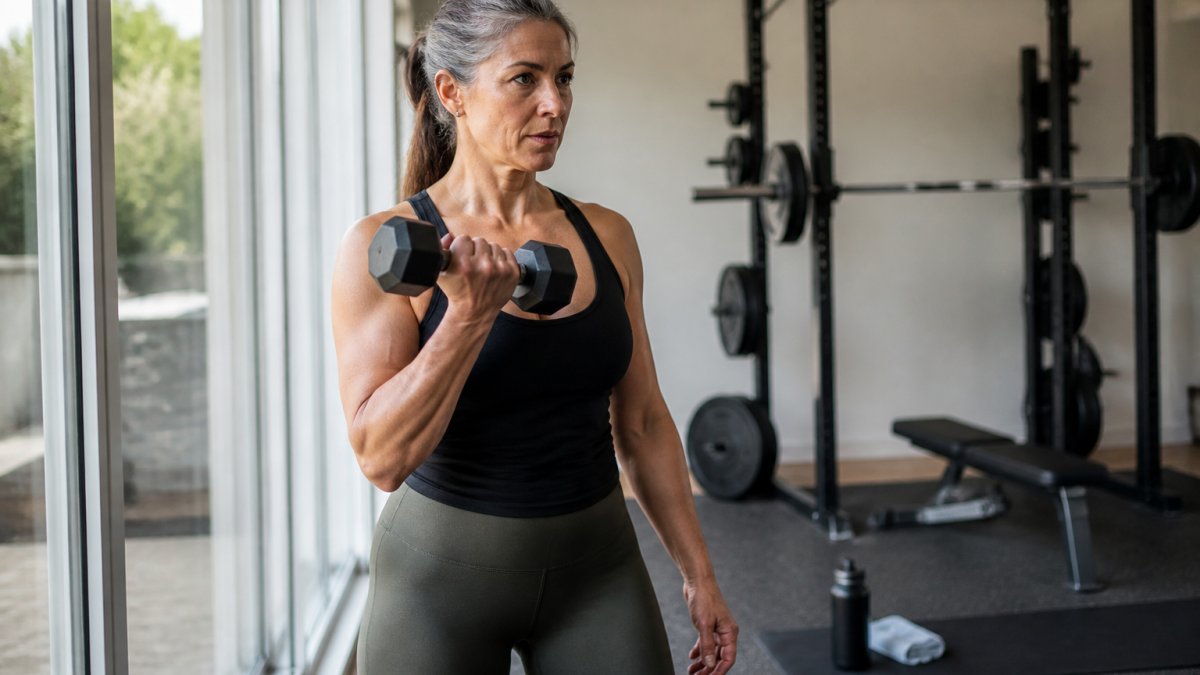
Strength training during menopause is the closest thing to a metabolism fix. Muscle burns more calories at rest than fat does, and resistance training is the main lever for preserving lean mass while you lose fat.
A Weekly Plan You Can Actually Follow
The plan below fits three strength sessions and two to three aerobic sessions into a normal week. Rest days are part of the program, not a failure of it.
| Day | Session | What It Looks Like |
|---|---|---|
| Monday | Full-body strength A | Squat, push, row, hinge, carry, 2 to 3 sets of 8 to 12 reps |
| Tuesday | Aerobic | 20 to 30 minutes brisk walking or cycling at a pace where you can talk but not sing |
| Wednesday | Rest or mobility | Easy walk, stretching, or yoga |
| Thursday | Full-body strength B | Hinge, pull, split squat, overhead press, core, 2 to 3 sets of 8 to 12 reps |
| Friday | Aerobic | 20 to 30 minutes, same effort as Tuesday |
| Saturday | Strength C or active recovery | Repeat strength A, or a longer walk or hike |
| Sunday | Rest | Recovery is when muscle is rebuilt |
The Five Movement Patterns
Every strength session is built from these patterns. Pick one exercise per pattern and rotate variations every four to six weeks.
- Squat, bodyweight squat, goblet squat, or leg press.
- Hinge, hip bridge, Romanian deadlift, or kettlebell deadlift.
- Push, wall push-up, incline push-up, or chest press.
- Pull, cable row, band row, or dumbbell row.
- Carry, farmer’s walk with dumbbells or kettlebells.
Do 2 to 3 sets of 8 to 12 reps. Add weight when the last rep of the last set feels easy with good form, that is the progression rule. If you cannot complete 8 reps with control, reduce the weight.
Aerobic Activity: The Complement, Not the Replacement
Walking and other aerobic activity help with heart health, mood, and calorie expenditure, but they do not replace resistance training. A reasonable target is about 150 minutes of moderate aerobic activity per week, which the plan above reaches with two 20-to-30-minute sessions plus daily walking. A 2020 study examined weight loss after menopause with minimal aerobic training, which suggests activity still matters even in small doses.
Modifications for Joint Pain or Low Fitness
Joint pain and low fitness are reasons to adjust the plan, not abandon it.
- Knees: swap deep squats for box squats or sit-to-stands from a chair.
- Shoulders: use neutral-grip presses and band pull-aparts instead of overhead pressing.
- Wrists: use dumbbells or handles rather than a straight bar.
If you are new to lifting, consider hiring a trainer. Learning the movements correctly protects your joints and back.
Track strength, not just weight. If your row or squat load is going up while your waist is holding steady, the plan is working even when the scale is quiet.
Hormone Therapy, Medications, and When to Get Help
Hormone therapy does not necessarily cause weight gain.
That said, HRT isn’t a weight-loss drug.
For a deeper look, read our 2026 guide to hormone replacement therapy for menopause symptoms.
Get help when:
- You’ve followed a real plan for three months with no change
- Your waist is growing despite effort
- You have other conditions or take medications that affect weight
A medical program can review labs, adjust treatment, and build a plan around your history. You can explore medical weight loss options to see what a clinical approach involves.
Weight changes in menopause are real, but they’re not a life sentence.
At GAYA Wellness, our board-certified OB/GYN and U.S. Navy veteran Dr.
Book a consult with GAYA Wellness and stop guessing about your weight.
Frequently Asked Questions
Can low estrogen cause weight gain?
Low and fluctuating estrogen changes where your body stores fat and how well it builds muscle. A 2021 review in the National Institutes of Health database reports that menopause is linked to more fat mass and less lean muscle mass. That shift can make weight regulation harder, but it does not mean weight gain is inevitable. The Australasian Menopause Society notes that hormonal changes can move fat toward the abdomen while stating that menopause itself does not cause weight gain. Your calorie intake, activity level, sleep, and medications still matter.
Does menopause slow your metabolism?
Partly, and mostly through muscle loss. The Mayo Clinic explains that losing muscle mass slows the rate at which the body uses calories, and a 2019 review on perimenopausal weight management describes a slower metabolic rate and physiological changes that can reduce calorie burning. A 2021 review adds that menopause is associated with decreased lean muscle mass. Strength training during menopause is the most direct way to defend that muscle and keep your calorie expenditure from dropping further.
What is the best diet for weight loss during perimenopause?
There is no single diet that wins. The best diet for weight loss during perimenopause is one you can sustain for years, built around protein at every meal, fiber from vegetables and whole grains, controlled portions, and fewer refined carbohydrates. Clinician guidance notes that weight lost on popular diets is likely to be regained, which makes long-term weight control harder. That points toward a steady calorie deficit with adequate protein rather than a short, severe restriction phase.
Can hormone therapy help with menopause-related weight gain?
It may help some women, but it is not a weight-loss drug. Research suggests hormone replacement therapy does not cause weight gain or make losing weight harder, and may help some women. Whether hormone therapy fits you depends on your symptoms, health history, and risk factors, so this is a conversation to have with a board-certified clinician who can review your labs and personal history rather than a decision to make from a search result.
