

Table of Contents
- Why Women Switch From Gennev to Other Menopause Platforms
- How to Choose a Menopause Specialist for Telehealth Care
- Top Menopause Telehealth Alternatives for Personalized Care
- Virtual Menopause Treatment Insurance Coverage Explained
- Evernow vs Winona Cost and Coverage Comparison
- What Sets GAYA Wellness Apart From Other Menopause Platforms
- Conclusion: Finding Your Right Menopause Telehealth Match
- Frequently Asked Questions
Last Updated: August 11, 2026

Why Women Switch From Gennev to Other Menopause Platforms
Women leave Gennev because they’re searching for something it doesn’t deliver. The menopause telehealth landscape has evolved, and different platforms now excel at different things. Some need insurance coverage that works seamlessly. Others want broader services beyond hormone optimization. Still others crave integrated community support.
GAYA Wellness understands this. Led by board-certified OB/GYN and U.S. Navy veteran Dr. Shweta Patel, GAYA Wellness uses a proprietary Hormonal Archetype™ framework and lab-based personalization to build care plans tailored to your unique hormonal patterns and life circumstances, rejecting the one-size-fits-most model entirely.
The real question isn’t which platform is universally best. It’s which platform solves YOUR specific problem.
How to Choose a Menopause Specialist for Telehealth Care
Choosing a menopause specialist requires evaluating five concrete factors. First, confirm board certification in obstetrics and gynecology or a related field. Menopause medicine requires specialized training beyond standard medical school rotations.

Second, assess symptom assessment depth. Does the platform use a simple checklist, or does it map symptoms against your complete medical history, medications, and lifestyle? A menopause-trained clinician asks about vasomotor symptoms, mood changes, sleep disruption, and sexual health, not just hot flashes in isolation.
Third, evaluate insurance compatibility. Some platforms accept major commercial insurance for consultations but charge separately for medications. Others operate on cash-pay models with transparent pricing. Your choice depends on coverage and whether you prefer predictable out-of-pocket costs or potential insurance reimbursement.
Fourth, consider continuity of care. Does the platform assign you a specific clinician who tracks progress over time, or rotate providers? For menopause care, continuity matters because effective hormone optimization requires adjustments based on how your body responds over months.
Finally, evaluate what happens beyond prescription management. Does the platform offer lifestyle coaching, nutritional guidance, or community support? These elements accelerate symptom relief far more than medication alone.
Top Menopause Telehealth Alternatives for Personalized Care
GAYA Wellness: Concierge Care With Proprietary Hormonal Archetype™ Framework
GAYA Wellness rejects the assembly-line model. Led by Dr. Shweta Patel, a board-certified OB/GYN and U.S. Navy veteran, it delivers concierge virtual and in-office care for women in the second half of their lives.
The core differentiator is the Hormonal Archetype™ framework, a proprietary system that categorizes women into distinct hormonal patterns based on comprehensive lab work, symptom profiles, and health history. Rather than prescribing the same hormone replacement therapy protocol to every woman, GAYA Wellness customizes everything: hormone types, dosages, delivery methods, and supporting interventions like medical weight loss or longevity medicine.
This solves a persistent problem with standard menopause care. GAYA Wellness offers comprehensive initial assessment, lab-based personalization, and ongoing optimization.
The practice offers three core services: hormone optimization, medical weight loss (addressing stubborn weight gain during perimenopause and menopause), and longevity medicine.
Pros:
- Board-certified OB/GYN leadership with specialized menopause expertise
- Proprietary Hormonal Archetype™ framework ensures truly personalized treatment plans
- Concierge model provides dedicated attention and continuity of care
- Integrated services: hormone optimization, medical weight loss, and longevity support in one practice
- Lab-based decision-making removes guesswork from treatment
- Both virtual and in-office options for flexibility
Cons:
- Concierge model typically means out-of-pocket costs (insurance coverage varies)
- Requires more upfront time investment in initial assessment
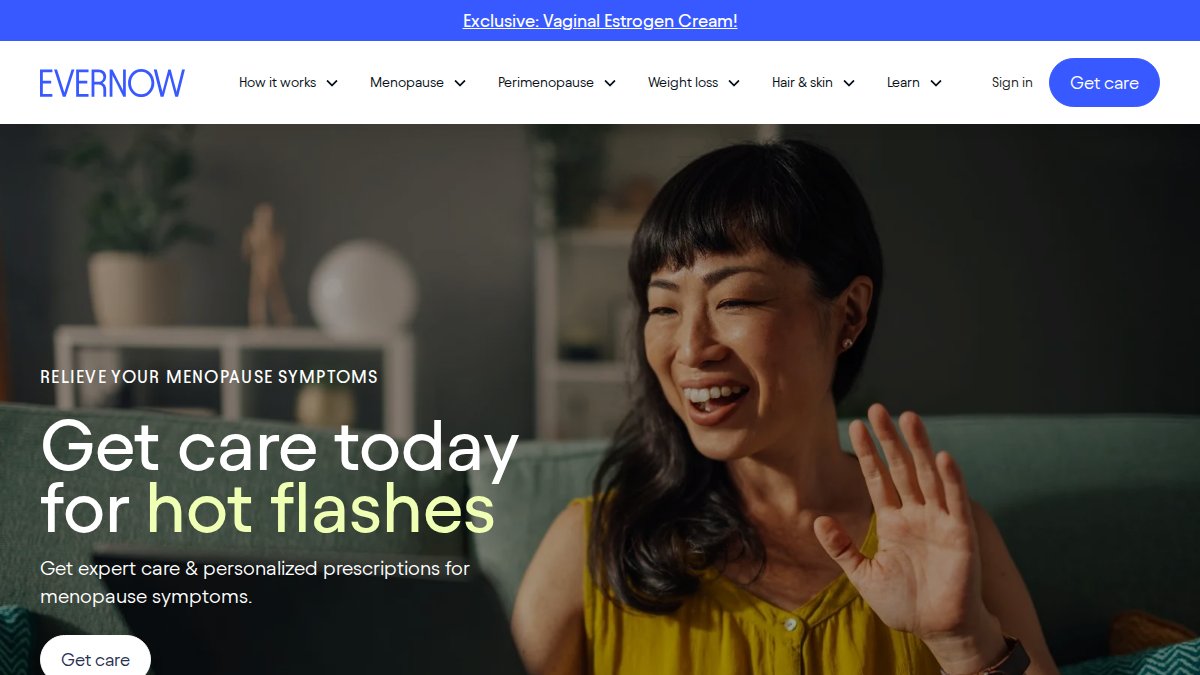
Evernow: Menopause-Trained Providers and Community Support
Evernow is built explicitly for menopause, pairing board-certified menopause specialists, MDs, NPs, OB/GYNs, and APRNs with FDA-approved bioidentical hormones and integrated community support.
Evernow’s strength lies in its focus. Unlike platforms bundling menopause with sexual health, skincare, and weight loss, Evernow stays laser-focused on menopause treatment, enabling deeper expertise in symptom management and hormone optimization.
Evernow offers flexible pricing: a subscription model starting at $29 per month for ongoing access, or pay-per-visit options. Some major commercial insurance plans cover video consultations, meaningfully reducing out-of-pocket costs. Medications are prescribed separately and often covered by insurance when filled at local pharmacies.
The platform includes a symptom-tracking app and educational resources, but the real value is the community component. Women gain access to peer support forums and group discussions, which research shows improves adherence and outcomes in menopause care.
Pros:
- Menopause-trained specialists across multiple disciplines
- Accepts major commercial insurance for consultations
- Flexible subscription and pay-per-visit options
- Integrated symptom tracking app
- Community support and peer forums included
- Medications often covered by insurance when filled at local pharmacy
- Available in all 50 states
Cons:
- Membership fees are not covered by insurance
- Medications cost separately from consultation fees
- Less comprehensive than platforms offering integrated weight loss or longevity services
Alloy Women’s Health: Comprehensive Midlife Care Beyond HRT
Alloy Women’s Health serves the full spectrum of midlife women’s health: menopause, sexual health, skincare, weight management, and hair and brow concerns. This breadth appeals to women who recognize that menopause doesn’t exist in isolation. Hot flashes intersect with vaginal dryness, which affects sexual function. Weight gain often requires medical intervention. Skin changes accelerate. Hair thins.
Alloy prescribes FDA-approved bioidentical and plant-based hormone therapies with transparent cash-pay pricing (no insurance billing). The platform accepts FSA and HSA cards, effectively reducing costs for many patients. Initial consultations start quickly, often within 12 business hours, and the subscription model begins at $39.99 per month, billed quarterly, plus a one-time consultation fee.
The trade-off is that Alloy doesn’t accept insurance. For women with strong coverage, this means higher out-of-pocket costs. For uninsured or underinsured women, the transparent cash-pay model can be cheaper than navigating insurance denials.
Pros:
- Comprehensive midlife health services beyond HRT (sexual health, skincare, weight management)
- Transparent cash-pay pricing with no insurance headaches
- Quick access to care (consultations often within 12 business hours)
- Accepts FSA and HSA cards for tax-advantaged payment
- FDA-approved bioidentical and plant-based hormone options
- One-stop shop for multiple midlife health concerns
Cons:
- Does not accept insurance, requiring full cash payment
- Additional one-time consultation fee on top of subscription
- May be more expensive for insured patients than insurance-accepting platforms

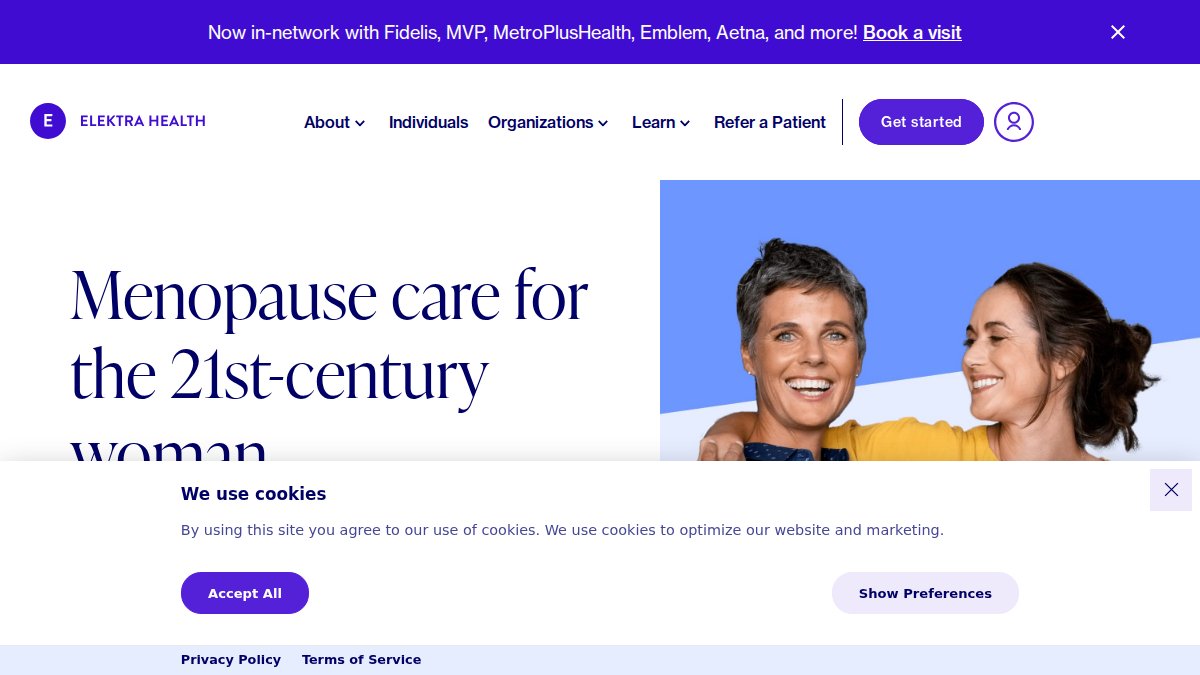
Elektra Health: Education-Focused Menopause Management
Elektra Health combines clinical care with structured education, recognizing that informed patients make better decisions about treatment. The platform pairs licensed menopause clinicians with a “menopause school” component featuring webinars, educational content, and community forums.
Elektra prescribes both FDA-approved hormone therapies and non-hormonal options. The platform accepts select commercial insurance plans for consultations, significantly reducing costs compared to cash-pay-only platforms. The per-visit model (ranging from $100 to $175 for cash-pay) appeals to women wanting flexibility without subscription commitment. Medications are billed separately.
Elektra’s differentiator is the educational layer. Women gain access to evidence-based content about menopause physiology, treatment options, and lifestyle modifications, helping them understand WHY their clinician recommends specific interventions.
Pros:
- Accepts select commercial insurance for consultations
- Educational programming and “menopause school” component included
- Menopause-trained clinicians with prescribing authority
- Flexible pay-per-visit model without subscription commitment
- Evidence-based content and community support
- Non-hormonal and hormonal treatment options available
Cons:
- Limited independent outcome data specific to Elektra’s patient population
- Medication costs separate from consultation fees
- Per-visit model can become expensive with frequent follow-ups
Virtual Menopause Treatment Insurance Coverage Explained
Insurance coverage for virtual menopause treatment varies dramatically depending on your plan, your provider’s network status, and whether you’re seeking consultation, medication, or both.
Most major commercial insurance plans cover video consultations with in-network providers at the same rate as in-person visits. However, many menopause telehealth platforms operate out-of-network, triggering higher out-of-pocket costs. Out-of-network coverage depends on your plan’s benefits, some cover 60-70% of the allowed amount, others don’t cover out-of-network telehealth at all. Before signing up, call your insurance company and ask: (1) whether the platform is in-network, and (2) what your out-of-network benefits are for virtual consultations.
Medications present a separate coverage question. Most insurance plans cover hormone replacement therapy medications when prescribed by any licensed provider and filled at a participating pharmacy. However, some plans have formulary restrictions, covering only certain hormone formulations. Compounded bioidentical hormones may not be covered, requiring full cash payment.
FSA and HSA accounts can be used to pay for telehealth consultations and medications, effectively reducing your true cost by 20-37% depending on your tax bracket. For uninsured women, the transparency of cash-pay platforms becomes valuable, you know exactly what you’re paying upfront without surprise bills or insurance denials.
Evernow vs Winona Cost and Coverage Comparison
Evernow operates a subscription-plus-pay-per-visit hybrid. Winona uses a membership model with bundled services.
Evernow’s subscription starts at $29 per month for ongoing access. Additional consultations are billed separately. If your insurance covers the consultation, you pay your copay or coinsurance. If you’re out-of-network, you pay the full consultation fee (typically $100-$200).
Winona’s membership model bundles consultations and some medications into a single monthly fee, appealing to women who want predictability.
| Factor | Evernow | Winona |
|---|---|---|
| Base subscription/membership | $29/month | Higher monthly fee |
| Insurance acceptance | Select plans accepted | Typically cash-pay |
| Medication costs | Separate; often covered by insurance | Often bundled into membership |
| Follow-up consultations | Additional cost | Included in membership |
| Best for | Insured patients; flexible usage | Uninsured patients; predictable budgeting |
For insured women, Evernow’s model often wins because insurance covers consultations and medications. For uninsured women, Winona’s bundled model provides cost certainty.
What Sets GAYA Wellness Apart From Other Menopause Platforms
GAYA Wellness operates as a concierge practice, not a platform designed to scale to millions of users. This shapes every decision.
The Hormonal Archetype™ framework is the clearest example. Rather than applying a standard hormone protocol to every woman, GAYA Wellness invests time in comprehensive assessment, lab work, detailed symptom mapping, and health history. This reveals which distinct hormonal pattern applies to you. Treatment flows from that understanding, not from a one-size-fits-most protocol.
This directly addresses a persistent complaint: feeling like a number in a system. GAYA Wellness offers a comprehensive initial consultation. Follow-ups are structured around objective measures: lab results, symptom tracking, and metabolic markers. Adjustments are driven by data, not guesswork.
The integration of medical weight loss and longevity medicine into the same practice also sets GAYA Wellness apart. Most menopause telehealth platforms treat hormone optimization as standalone. But perimenopause and menopause trigger metabolic shifts that make weight management harder. Estrogen decline accelerates bone loss and increases cardiovascular risk. GAYA Wellness addresses these interconnected changes within a single, coordinated care model.
Dr. Shweta Patel’s background as both a board-certified OB/GYN and U.S. Navy veteran shapes the practice’s philosophy, emphasizing data-driven decision-making, personalization, and long-term health optimization.
For women who’ve felt dismissed by traditional healthcare or who recognize that menopause isn’t one-size-fits-all, GAYA Wellness offers genuine personalization backed by clinical expertise and proprietary methodology.
Conclusion: Finding Your Right Menopause Telehealth Match
Choosing a menopause telehealth platform requires honest assessment of what you need most: insurance compatibility, comprehensive midlife services, community support, educational resources, or true personalization driven by proprietary frameworks and board-certified expertise.
The menopause platforms reshaping women’s healthcare in 2026 share a common insight: one-size-fits-most care fails. Women deserve options tailored to their hormonal patterns, life circumstances, and health goals. GAYA Wellness delivers this through the Hormonal Archetype™ framework and concierge-level personalization. Whether GAYA Wellness is your match depends on whether you prioritize comprehensive, data-driven hormone optimization and medical weight loss management alongside longevity support, and whether you value continuity of care with a board-certified OB/GYN who specializes in women’s health in the second half of life.
The real difference between adequate menopause care and transformative care comes down to one factor: does your provider treat menopause as a checkbox to manage, or as a complex health transition requiring personalization? GAYA Wellness operates from the latter premise. Book a consultation with Dr. Shweta Patel and the team to explore how the Hormonal Archetype™ framework and integrated medical weight loss support can address your specific menopause experience, with clear, lab-based plans replacing guesswork.
Frequently Asked Questions
What should I look for in a menopause telehealth provider?
Prioritize board-certified clinicians trained in menopause care, ideally OB/GYNs, NPs, or APRNs with specific menopause expertise. Check whether they offer personalized treatment plans based on lab work and symptom assessment, not just standard protocols. Verify insurance acceptance or transparent pricing. Look for integrated care that addresses hormone replacement therapy, lifestyle modifications, and symptom tracking. Finally, ensure the platform provides ongoing support through messaging, follow-up visits, and access to registered dietitian nutritionists or wellness coaches.
Does insurance cover virtual menopause treatment?
Coverage varies by plan and provider. Many menopause telehealth platforms accept select commercial insurance for video consultations, which can reduce out-of-pocket costs for visits. However, membership fees are typically not covered by insurance. Prescription medications may be covered if filled through your insurance-contracted pharmacy, depending on your plan’s formulary. Out-of-network benefits may apply if your plan includes them. Contact your insurance provider directly to verify coverage before signing up, as policies differ significantly.
How do Evernow and other menopause platforms differ in cost?
Pricing models vary significantly. Evernow offers both subscription ($29/month) and pay-per-visit options, with medication costs separate and often covered by insurance if filled through a pharmacy. Alloy Women’s Health charges $39.99/month (quarterly billing) plus a one-time consultation fee and does not accept insurance. Elektra Health charges $100-$175 per follow-up visit on a cash-pay basis with optional membership for educational content. Compare your insurance coverage, frequency of care needed, and whether you prefer predictable subscription costs versus pay-as-you-go pricing.
What are the best alternatives to Gennev for menopause care?
Top alternatives include Evernow for menopause-trained providers and community support, Alloy Women’s Health for comprehensive midlife care beyond HRT, and Elektra Health for education-focused menopause management with clinical oversight. Each platform offers different strengths: Evernow excels in flexibility and insurance acceptance, Alloy provides broader services like weight care and skincare, and Elektra emphasizes educational programming. Your choice depends on your specific needs, insurance situation, and preference for additional services beyond hormone optimization.
Can I use telehealth menopause care if I travel frequently?
Yes, most menopause telehealth platforms operate across all 50 states and are designed for remote access, making them ideal for frequent travelers. Video consultations, symptom tracking apps, and prescription management can all be done from anywhere. However, verify that your chosen provider is licensed in your state and that any medications can be filled at pharmacies where you travel. Concierge practices may offer additional flexibility for patients with variable schedules, including asynchronous messaging and flexible appointment timing to accommodate travel demands.
This article was written using GrandRanker